Tuesday, February 5, 2013

The little island(s) that grew (Part 2)...

I'll spend one more day musing about Pulau Bukom, the island I grew up in. There was a big oil refinery complex fire there on Dec 28, 2011. Someone posted online this graphic:


This picture helps to update me. Apart from Bukom itself (also called Bukom Besar) and Bukom Kechil, it would seem that Anak Bukom was actually reclaimed from Pulau Ular. And it looks like Pulau Busing has since been integrated into the Bukom cluster.

I remember Pulau Hantu. When I was little, and my visiting eldest brother Tee Chuan was courting his future wife, Paik Sim, they hired a boat to get there for an idyllic swim. I went along, either because they found me so cute they just had to take me too, or my conservative parents insisted that little ol' me should act as chaperon. I never knew which!

Bukom itself, before all the oil storage tanks multiplied manifold, was zoned into residential clusters. There was Barat (West, in Malay) which in the picture above, would be on the extreme right. Timor (East) was on the extreme left. I lived in Tengah (centre). Here's a pic of me in our company-supplied and very spacious house, hoping that when I grew up, I would be able to ride a scooter like my father...

    
Bukom was quite modern by the time I went to primary school there. But, if this picture is correct, there were still fishing villages when I was three to four years old!...


Frankly, I don't remember such a scene. But I recall swimming in the sea, although I found only pics of me in the community swimming pool:


There were Christmas parties for employees' children every year. Remember this one, from a previous blog entry?...


I didn't look happy. But I seemed to be more cheerful in this pic, even if the haircut was something else (I think it was my father's tonsorial handiwork; he was quite a DIY man... he once pulled out a decaying tooth of mine, ouch!!)...


Just one more Christmas party pic (no, I'm not the boy being poked on the cheek)...


I was in Primary 6 when there was a lot of hoohah over the prospect of Singapore gaining its independence from the colonial Brits by way of merger with neighbours to form Malaysia. Some of the pics here are from the photo album we had to fill up as part of a school assignment:


 I found, from the album, two pics of my primary school:


Bukomites (yes, that was how we called ourselves) got to mainland Singapore by ferry from the island's East Gate. The terminals at the mainland end were at Jardine Steps (Tanjong Berlayar precinct) and Collyer Quay  ("Ang Teng" in Hokkien, meaning Red Lantern).

The names of our ferries included Chantek, Bongsu, Kerang, and Laju (picture below):

     
Laju became "famous" -- it was hijacked by terrorists on Jan 31, 1974. If you want to know more about that incident, simply do a Google search.

Finally, I was surprised that in Washington DC, USA, there's this!...


What a strange world! Here's the website:

http://www.bukom.com/

But, no, in our neck of the world, "Bukom" is not of Ethopian origin; it came from the Malay language, as per this website:

http://infopedia.nl.sg/articles/SIP_922_2005-01-19.html

Monday, February 4, 2013

The little island(s) that grew and grew!

Bukom -- my childhood island in the sun -- was in the news. ST (Feb 4) published the changing outline of the map of Singapore, as part of its story on government plans to transform the Little Red Dot to accommodate more people by 2030. And of course, Pulau Bukom (and its satellite islands) was included. But first, Singapore from 1966 to 2012, and the projection for 2030. I wonder how many people are able to locate Bukom, from the four ST graphics below:


For sure, the Shell Company has been expanding Pulau Bukom and Pulau Bukom Kechil for the longest time, and it has even created a new islet, Pulau Anak Bukom. All three features are now linked. I tried to "zoom in" on the four graphics above, but -- because the graphics were small-sized -- the results are not sharp at all:


Despite the grainy results, Bukom and Bukom Kechil were accurately depicted circa 1966 as two separate islands. By the time of the 2002 graphic, Anak had been created (but I am not sure when). From the last graphic, the Bukom that I knew as a boy would have been transformed beyond recognition.

I found from the Internet this undated map:


There is also this aerial view of the modern-day Pulau Bukom complex, which I had also used previously:


I'll continue with my reflections on this topic tomorrow, in Part 2. But before wrapping up, I think this FT article in TODAY (Feb 4) on the geopolitical import of Myanmar is worth a read:


Sunday, February 3, 2013

As a Chinese saying goes, 'May you live in interesting times'...

While going through some of my clippings, I came across these two from last year:


 ------------------------------------------------------------

I wondered yesterday if the dynamic for China in the South China Sea had changed since the few years before the turn of the century, after it had made several forays into the Spratly Islands, then settled into a period of uneasy accommodation with the Asean claimant countries.

This article below, aptly headlined "Danger of sleepwalking diplomacy in East Asia", by a former foreign minister of South Korea, is somewhat pessimistic about accommodation among the major players engaged in East Asia, with both the South and East China seas possibly becoming a replay of the great power bungles on the eve of World War One.

He observes especially that historically, "rising powers tend to become too confident too soon, leading them to behave imprudently, which frightens their neighbours". Regarding the South China Sea, he says: "the rhetoric of some Chinese, particularly in the military... suggests that not everyone in the country's leadership is committed wholeheartedly to the [path of peaceful development]"...


------------------------------------------------------------------------

So, if great power politics is so scary, Brewster Rockit has the answer...


------------------------------------------------------------------------

More on Year of the Sssssssnake...


What a way to boot out the Year of the Dragon! I wonder if this man is now turning in his grave...


The build-up to the Year of the Snake could get worse... like this Snake And Ladder hongbao!...


Saturday, February 2, 2013

Rule No 1: Big dogs set the other rules?

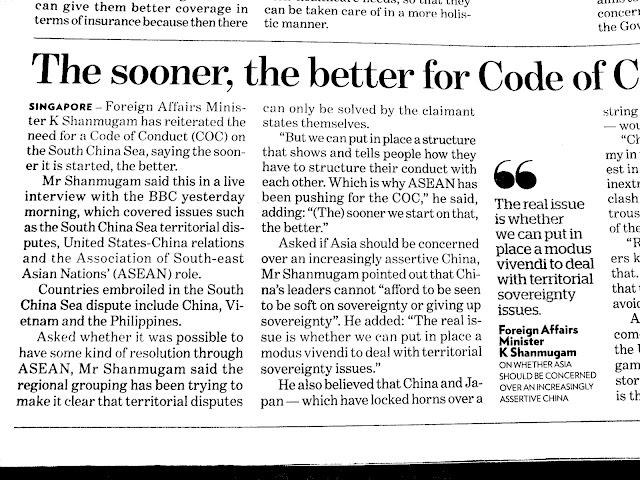
I do not know why Singapore is pushing so hard for a Code of Conduct for the South China Sea, which -- because such a code has to be rules-based and even may need to provide for dispute resolution -- will only anger China, which has no interest in such a code, apart from likely imposing further strains on Asean's fragile cohesion:


I am sure Lee Kuan Yew's influence on Singapore's strategic thinking and foreign policy positions -- including his projections about China's international behaviour -- remains undiminished. So, I wish someone would ask him, "Do you think a Code of Conduct can be achieved in the South China Sea, one that imposes rules and punishments, not one that is just an exercise in diplomacy with escape clauses?" The Financial Times op-ed below, while providing insights into Lee's thinking, gives no clue as to his views on such a code:

Beijing Still Prefers Diplomacy Over Force
http://belfercenter.ksg.harvard.edu/publication/22702/beijing_still_prefers_diplomacy_over_force.html?utm_source=SilverpopMailing&utm_medium=email&utm_campaign=BIN%2001.28.13%20(1)&utm_content=

Lee did, in 1995 in the aftermath of the Mischief Reef incidents in the Spratlys (part of the South China Sea), make this comment: "[China was more] like a big dog going up against a tree, lifting his leg to mark the tree, so that smaller dogs will know that a big dog has been there, and to take note of that".

Perhaps that particular dynamic has changed since 1995. If so, how?

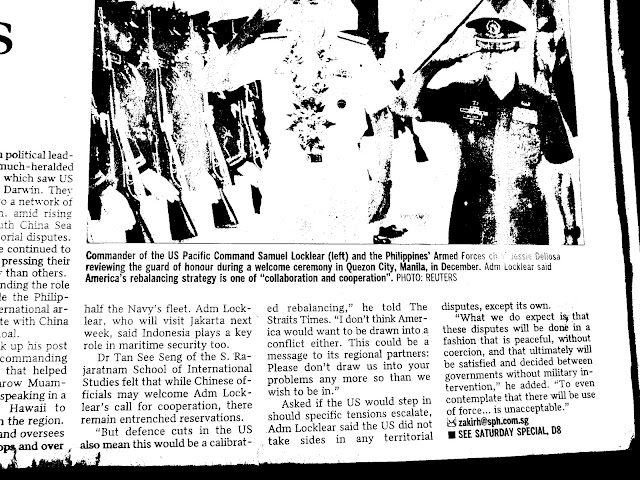
But one dynamic still seems relevant, at least for the immediate if not longer-term future: the US is still welcome in the region, and moves are being stepped up to get China into the equation:


-------------------------------------------------------------------

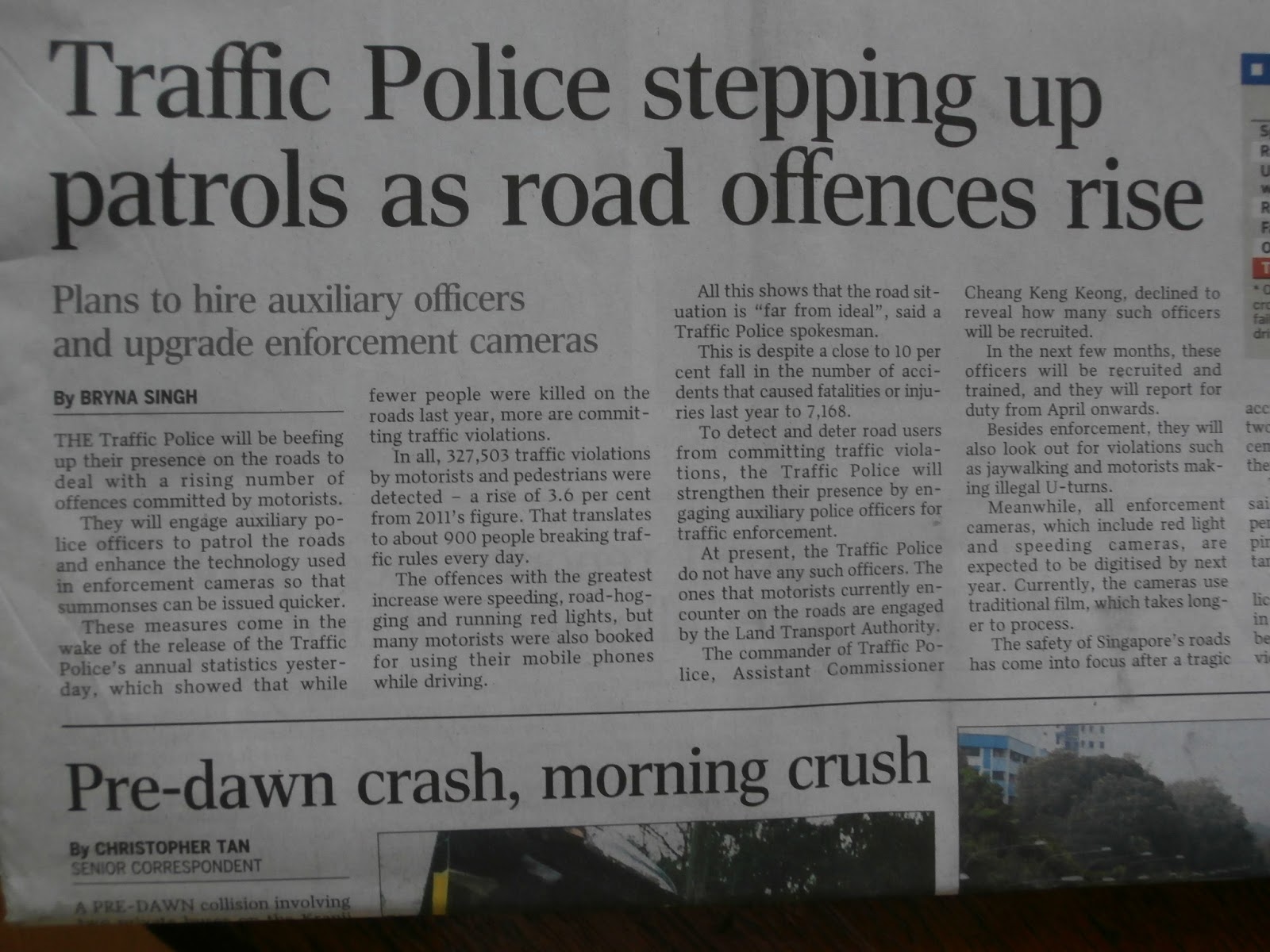
Speaking of rules -- and the breaking of rules -- motorists in Singapore can expect to see more traffic cops on the prowl and up (and concealed) at pedestrian overpasses. So, don't be so quick on the draw at the traffic lights, hor:


----------------------------------------------------

Sure, quick on the draw, but...

Finally, I wonder how do cowboys "do it" when they "gotta go"?


I mean, yeah, they all looked -- in the movies -- like they were the fastest gun-slingers in the west. But if you have to keep looking over your shoulder all the time in the bad, bad, wild,wild west, in case a baddie comes up and shoots you in the back, how do you take a leak and still keep that shooter handy? Hmmm, a weekend poser... but don't expect the movies to clue us in.

Friday, February 1, 2013

Road sense and sensibility, sensing a zebra fish's thoughts, and footballers' own goal!

The recent tragic deaths of two young boys -- they were on a bicycle with one riding pillion when they were involved in an accident with a cement truck -- have led to questions that basically centre on humans vs system, ie, how can all manner of (human) road users co-exist; and how can the (non-human) traffic system be fine-tuned to "help" in this objective.

There is a further dimension: are Singaporeans especially "weird" road users? You know what I mean: pedestrians who cross the road looking the other way, joggers who run in front of your car rather than get behind when yours is the first car at a stop waiting to move through, motorists who cut in abruptly just because they have suddenly signalled their intention, etc, etc.

I found this survey that TODAY published some time back:


And, not unexpectedly, the recent fatal accident has sparked letters to the media. Here are four I felt are worth some thought (three in ST, one in TODAY):


-----------------------------------------------------------------

On a more cerebral note, this is a fascinating story...

Scientists record the first video of thoughts forming in the brain

http://io9.com/5980811/scientists-record-the-first-video-of-thoughts-forming-in-the-brain?utm_source=jezebel.com&utm_medium=recirculation&utm_campaign=recirculation

---------------------------------------------------------------------

On a less cerebral note, this is an interesting story (from Thursday's New Paper), at least from the perspective of a journalist!...


Finally, on a (sort of) related note, ST carried this story recently: