From the lips of the prime minister to the those of the leader of the opposition and other MPs, two words -- "constructive politics" -- have been expounded on and dissected in the current session of Parliament, and splashed across local newspaper headlines. Also tossed into the parliamentary chambers were admonitions about the dangers of destructive "money politics, power politics, racial politics and the politics of envy".
Whew! I am glad the PM then took time out from all that heated exchange -- during which no definition of what politics really is was tendered -- to expound on "holesome politics" (my coinage) in an egalitarian Singapore. Yes, holesome, as in...
I thought, "Hey, this is both a political statement and a fashion statement", which I too could wear on my sleeve. So I looked for my own shirts with holes in them but, alas, I found none. I swore I had a few but the better half must have disposed of them. Not very egalitarian, I thought.
But I then realised I could keep in step with -- and even steal a march on -- the emerging "politics of holes":
These are very comfortable Crocs shoes -- and I still wear them. I had to stay one step ahead of Angie who had threatened to get rid of them. But that danger dissipated, after she recently bought herself a pair of women's Crocs shoes. She is now a convert to the cause; on the Crocs side, so to speak. There are no holes in them yet. They are still new and wholesome, not yet holesome.
Thursday, May 29, 2014
Wednesday, May 28, 2014
Did you catch out these headlines?
The basic subject-verb agreement...
...as I have noted, so many checkers at ST, yet errors like this one crop up ("go", not "goes").
________________________________________________________
What did the pigeon want?...
...the best bottle teat? Show me a pigeon that suckles on a milk bottle and I'll show you a headline writer who thinks everyone knows that there is a brand of bottle teats called Pigeon:
_____________________________________________________
Hello, there're tears (as in when you cry) and there're tears (as in when something gets ripped)...
_______________________________________________________
And the weirdest headline this round is this one...
So, if you "age successfully", it should mean you look old, haggard, wizened, etc, right? If you "age unsuccessfully", it means you failed to age! You still look youthful even if you are 90 years old. Shame on you! You failed! You are required to "age successfully".
________________________________________________________________
Finally, decide for yourself if this poem here describes ageing successfully or ageing unsuccessfully...
A Little Poem

Another year has passed
And we're all a little older.
Last summer felt hotter
And winter seems much colder.

There was a time not long ago
When life was quite a blast.
Now I fully understand
About 'Living in the Past'

We used to go to weddings,
Football games and lunches.
Now we go to funeral homes
And after-funeral brunches.
We used to have hangovers,
From parties that were gay.
Now we suffer body aches
And while the night away.

We used to go out dining,
And couldn't get our fill.
Now we ask for doggie bags,
Come home and take a pill.

We used to often travel
To places near and far.
Now we get sore asses
From riding in the car.

We used to go to nightclubs
And drink a little booze.
Now we stay home at night
And watch the evening news.

That, my friend is how life is,
And now my tale is told.
So, enjoy each day and live it up...
Before you're too damned old!
...as I have noted, so many checkers at ST, yet errors like this one crop up ("go", not "goes").
________________________________________________________
What did the pigeon want?...
...the best bottle teat? Show me a pigeon that suckles on a milk bottle and I'll show you a headline writer who thinks everyone knows that there is a brand of bottle teats called Pigeon:
_____________________________________________________
Hello, there're tears (as in when you cry) and there're tears (as in when something gets ripped)...
_______________________________________________________
And the weirdest headline this round is this one...
So, if you "age successfully", it should mean you look old, haggard, wizened, etc, right? If you "age unsuccessfully", it means you failed to age! You still look youthful even if you are 90 years old. Shame on you! You failed! You are required to "age successfully".
________________________________________________________________
Finally, decide for yourself if this poem here describes ageing successfully or ageing unsuccessfully...
A Little Poem
Another year has passed
And we're all a little older.
Last summer felt hotter
And winter seems much colder.
There was a time not long ago
When life was quite a blast.
Now I fully understand
About 'Living in the Past'
We used to go to weddings,
Football games and lunches.
Now we go to funeral homes
And after-funeral brunches.
We used to have hangovers,
From parties that were gay.
Now we suffer body aches
And while the night away.
We used to go out dining,
And couldn't get our fill.
Now we ask for doggie bags,
Come home and take a pill.
We used to often travel
To places near and far.
Now we get sore asses
From riding in the car.
We used to go to nightclubs
And drink a little booze.
Now we stay home at night
And watch the evening news.
That, my friend is how life is,
And now my tale is told.
So, enjoy each day and live it up...
Before you're too damned old!
Tuesday, May 27, 2014
A Shinzo Abe joke, and other matters of interest...
An original (not mine) Shinzo Abe joke
Japanese PM Shinzo Abe will be coming to Singapore to deliver the keynote speech at a security conference, the Shangri-la Dialogue. US Defence Secretary Chuck Hagel will be here too.
Irene Hoe concocted this delightful piece of witticism and put it on her Facebook wall...
Abe arrives at Changi Airport and it is his turn to go up to the Immigration counter.
Name?
"Abe. Shinzo Abe."
Nationality?
"Japanese."
Occupation?
"No, I'm here for just a few days."
____________________________________
What's the matter? Don't you get this joke?
It was really good (if you did not get the joke, you need to know the wartime history). I couldn't think of a witty riposte. I thought of something along this line but I doubt if it's up to par...
Just then, Mr Abe saw Mr Hagel, having already cleared Immigration, rushing to get to the nearest toilet.
Hey, Chuck, long time no see.
"Sorry, Shinzo, I'm in a hurry. Gotta Bomb Tokyo!"
I wonder how many of the postwar baby boomers (like me) remembered this politically incorrect term -- to Bomb Tokyo? I learnt it from my late father and older brothers. I checked with Tom (a "Pioneer Generation" inductee) but he was clueless. Angie knew it, though. She learnt it from her dad too (her mum has a less historically-laced variation: Going to the Bank to make a Deposit.)
I then did an online check and found an American link, by way of the Urban Dictionary:
Tokyo Bomb
http://www.urbandictionary.com/define.php?term=tokyo%20bomb
_____________________________________________
Okay, the scatological part is done. This TODAY letter writer (May 27) makes a valid case in commenting on China's behaviour in the South China Sea. He seems to have done good research:
If this person is right, the bigger fish don't always eat up the smaller fish and everyone of them may still swim about peaceably (with the appropriate carrots and sticks in place?):
Of course, there is also the belief in an inviolable law, that of "bigger fish (eventually) eating up smaller fish"...
_________________________________________________
I had blogged about "small fish" Taiwan possessing the biggest island -- Itu Aba (Tai Ping) -- in the Spratlys region of the South China Sea. Not many people (including, I suspect, folks in "big fish" China) knew this. But now they do! (ST, May 27)...
__________________________________________________
Finally, poor Taiwan! A Canadian newspaper dragged it into Thailand's political mess...
Monday, May 26, 2014
No, don't give up on English!
I was asked: what are the differences between the study of English (the language), English literature and English linguistics? I can only attempt an answer as a layman practitioner, not as someone who had taken academic courses in the different areas of English Studies. I attempt the "fools rush in" exercise below with the caveat that I might be writing nonsense.
To me, the starting point is: what is language? It is a means of communication, artistic expression (Wikipedia) and "record keeping". It is hence both spoken and written. Without going into how the English language arose and evolved into the various "Englishes" that exist today, and their continuing adaptation, we might note that:
* there has to be rules, from that broad category referred to as grammar to specific areas such as linguistics (for example, speech sounds and non-speech sounds) and language meaning (for example, semantics).
* one can "learn English" through a formal step by step process, as is done through, say, the school system and adult education programmes.
* but one can also be immersed in it and, I suppose, learn English through "trial and error".
* English is, fortunately, not a multi-tonal language but it has its pitfalls for the learner (and even its practitioner) since many of its rules are not consistent.
To come back to the question posed to me, I would say that:
* the study of English up to the secondary/post-secondary school level is principally (but not exclusively) for the purpose of communication and includes the basic rules especially of grammar and phonetics, as well as the study of literary works (including poetry, theatre and drama) which is meant to impart reflection and analysis.
* beyond the secondary/post-secondary level, the study of both linguistics and literature goes in-depth (a rarefied group presumably delves deeper into the grammar and other aspects). Indeed, a university Department of English and Linguistics typically expects its students to be already proficient in the language and, beyond the requisite "101" modules, to go on to attain a high level of skill in discourse, research, analysis and critique.
* I should add that those who intend to teach English will require training in the language's pedagogy, that is, instructional methods.
________________________________________________
Having said all that, one should always have fun with the English language. It is never boring, even if it is often infuriating. Exhibit A below has been making the rounds online:
Sunday, May 25, 2014
Strange laws, fascinating facts...
It is always good to be aware of strange foreign laws -- when you visit other countries for business or pleasure. Readers' Digest had this short list...
So in Singapore, walk around naked in your own home at your risk! It is also good to know that, on our MRT trains, you can't do these things below, including taking on board durians:
___________________________________________________________
Then there are fascinating facts...
So in Singapore, walk around naked in your own home at your risk! It is also good to know that, on our MRT trains, you can't do these things below, including taking on board durians:
___________________________________________________________
Then there are fascinating facts...
Fascinating General Knowledge Facts.
What is more important, food or sleep? Why is one of our lungs smaller than the other, and what's the best thing to drink when you want to minimize smoke damage to your body? These fascinating facts delve into dozens of different general knowledge areas to enrich our overall knowledge, and make sure you have some pretty interesting things to ponder.
Saturday, May 24, 2014
Just an ordinary painting...
A wealthy man and his son loved to collect rare works of art.
'We have $10, who will bid $20?'
'Give it to him for $10. Let's see the masters.'
The crowd was becoming angry. They didn't want the picture of the son.
They wanted the more worthy investments for their collections.
The auctioneer pounded the gavel.. 'Going once, twice, SOLD for $10!'
A man sitting on the second row shouted, 'Now let's get on with the collection!'
The auctioneer laid down his gavel. 'I'm sorry, the auction is over.'
'What about the paintings?'
'I am sorry. When I was called to conduct this auction, I was told of a secret stipulation in the will... I was not allowed to reveal that stipulation until this time.
Only the painting of the son would be auctioned. Whoever bought that painting would inherit the entire estate, including the paintings.
The man who took the son gets everything!'
God gave His son over 2,000 years ago to die on the Cross.
They had everything in their collection, from Picasso to Raphael.
They would often sit together and admire the great works of art.
When the war broke out, the son did his duty.
He was very courageous and died in battle while rescuing another soldier.
The father was notified and grieved deeply for his only son.
About a month later, just before Christmas,
here was a knock at the door.
A young man stood at the door with a large package in his hands.
He said, 'Sir, you don't know me, but I am the soldier for whom your son gave his life.
About a month later, just before Christmas,
here was a knock at the door.
A young man stood at the door with a large package in his hands.
He said, 'Sir, you don't know me, but I am the soldier for whom your son gave his life.
He saved many lives that day, and he was carrying me to safety when a bullet struck him in the heart and he died instantly... He often talked about you, and your love for art.'
The young man held out this package. 'I know this isn't much. I'm not really a great artist, but I think your son would have wanted you to have this.'
The father opened the package.
It was a portrait of his son, painted by the young man.
He stared in awe at the way the soldier had captured the personality of his son in the painting. The father was so drawn to the eyes that his own eyes welled up with tears.
He thanked the young man and offered to pay him for the picture.
'Oh, no sir, I could never repay what your son did for me. It's a gift.'
The father hung the portrait over his mantle.
Every time visitors came to his home he took them to see the portrait of his son before he showed them any of the other great works he had collected.
The man died a few months later.
There was to be a great auction of his paintings.
Many influential people gathered, excited over seeing the great paintings and having an opportunity to purchase one for their collection.
On the platform sat the painting of the son.
Many influential people gathered, excited over seeing the great paintings and having an opportunity to purchase one for their collection.
On the platform sat the painting of the son.
The auctioneer pounded his gavel. 'We will start the bidding with this picture of the son. Who will bid for this picture?'
There was silence...
Then a voice in the back of the room shouted,
There was silence...
Then a voice in the back of the room shouted,
'We want to see the famous paintings. Skip this one.'
But the auctioneer persisted. 'Will somebody bid for this painting?
Who will start the bidding?
$100, $200?'
Another voice angrily. 'We didn't come to see this painting. We came to see the Van Gogh's, the Rembrandts. Get on with the real bids!'
But still the auctioneer continued. 'The son! The son! Who'll take the son?'
Finally, a voice came from the very back of the room.
$100, $200?'
Another voice angrily. 'We didn't come to see this painting. We came to see the Van Gogh's, the Rembrandts. Get on with the real bids!'
But still the auctioneer continued. 'The son! The son! Who'll take the son?'
Finally, a voice came from the very back of the room.
It was the longtime gardener of the man and his son. 'I'll give $10 for the painting.' Being a poor man, it was all he could afford.
'We have $10, who will bid $20?'
'Give it to him for $10. Let's see the masters.'
The crowd was becoming angry. They didn't want the picture of the son.
They wanted the more worthy investments for their collections.
The auctioneer pounded the gavel.. 'Going once, twice, SOLD for $10!'
A man sitting on the second row shouted, 'Now let's get on with the collection!'
The auctioneer laid down his gavel. 'I'm sorry, the auction is over.'
'What about the paintings?'
'I am sorry. When I was called to conduct this auction, I was told of a secret stipulation in the will... I was not allowed to reveal that stipulation until this time.
Only the painting of the son would be auctioned. Whoever bought that painting would inherit the entire estate, including the paintings.
The man who took the son gets everything!'
God gave His son over 2,000 years ago to die on the Cross.
Much like the auctioneer...
His message today is: 'The Son, the Son, who'll take the Son?'
Because, you see, whoever takes the Son gets everything!
FOR GOD SO LOVED THE WORLD HE GAVE HIS ONLY BEGOTTEN SON,
Because, you see, whoever takes the Son gets everything!
FOR GOD SO LOVED THE WORLD HE GAVE HIS ONLY BEGOTTEN SON,
WHO SO EVER BELIEVETH, SHALL HAVE ETERNAL LIFE...THAT'S LOVE.
Friday, May 23, 2014
Crystal ball gazing...
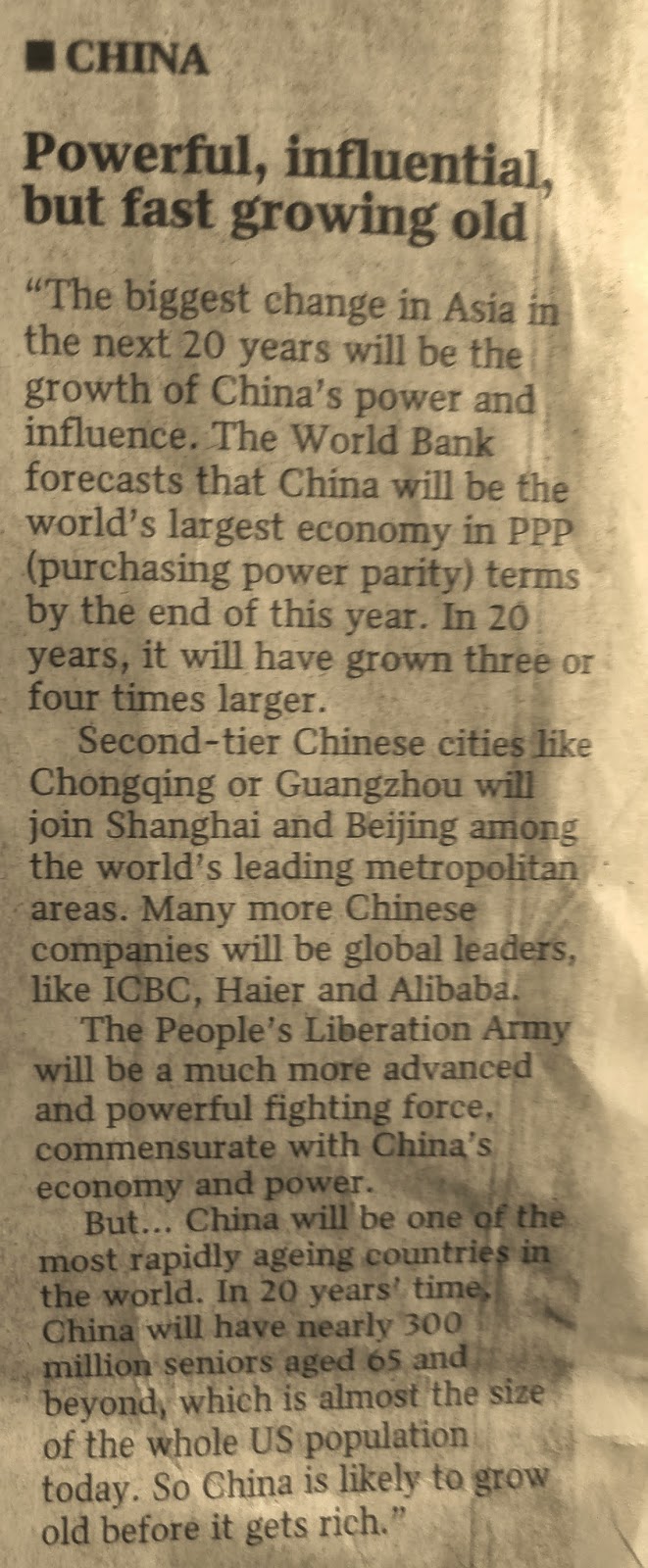
PM Lee gave the keynote speech at a conference in Tokyo:
Peering into his crystal ball, he sketched this possible scenario for China:
I beg to differ on that last part about the consequence of China growing old before it can get rich. Think of America on the cusp of its sustained century-plus of growth and innovation. It was a vacuum cleaner, sucking in immigrants from all over the world:
"Give me your tired, your poor,
Your huddled masses yearning to breathe free,
The wretched refuse of your teeming shore.
Send these, the homeless, tempest-tossed to me,
I lift my lamp beside the golden door!"
My take is that China at some point will be so self-confident that it will -- like a vacuum cleaner too -- suck in the young, talented and eager from the vast Chinese diaspora. But unlike early-industrializing America, latter-day China will not be choosing the poor, huddled masses, but fresh-off-the-boat youth to fill up its ranks. And they will come, lured by the opportunities. As for the unfortunate "target" countries, there might be a hollowing out of talented young Chinese!
America has its Statue of Liberty. How ironic then that, in a future China, a Goddess of Democracy-like statue might beckon new immigrants:
_________________________________________________
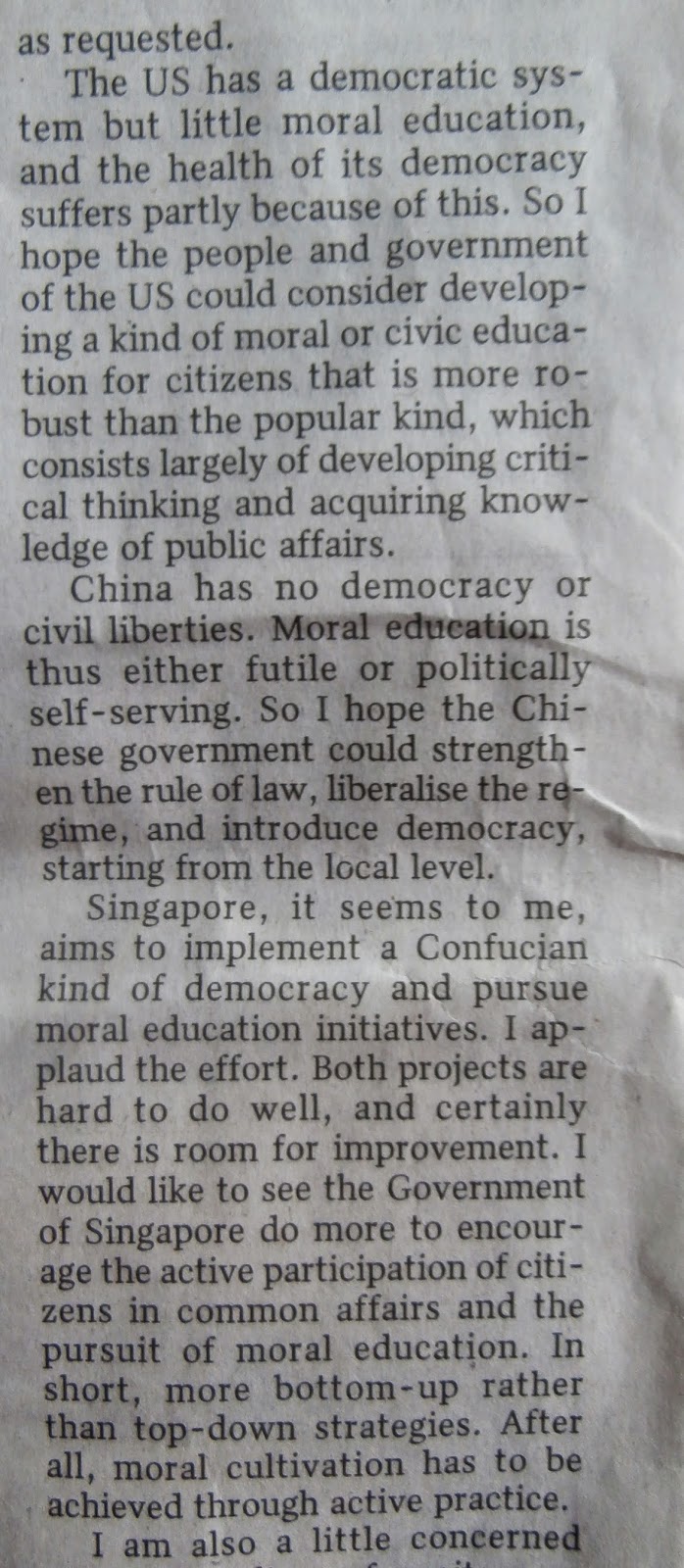
In this future China, will it become more democratic? Or more Confucian? ST ran this interesting commentary (May 23) by Hong Kong University scholar Joseph Chan:
There was this interesting concluding segment -- regarding Singapore:
_________________________________________________________
I'll wrap up with some other stuff spotted in ST (May 23):
Infrantry? At least the SAF wasn't planning to acquire more "frighting vehicles"!
Irascible? Of the dozen people I polled, half did not know what it meant. All of the four journalists agreed it should not have been used in a headline. There are better alternatives. Take your pick...
But, happily, I found something I could praise. I like this headline below:
Subscribe to:
Posts (Atom)
.jpg)
.jpg)
.jpg)
.jpg)